

Discover how to measure space utilization, identify unused periods, and optimize the allocation of rooms within your clinic.
Why Measure Your Clinic’s Space Utilization Rate?
In a clinic or Family Medicine Group (FMG), the number of rooms, their layout, equipment, and proximity to one another are all important considerations. Every office, consultation room, and workspace must be available at the right time to enable healthcare professionals to see their patients and deliver their services efficiently.
Yet, do you really know how effectively your spaces are being used? Are some rooms regularly unoccupied while others are in high demand? Are certain days particularly busy, while others have several slow periods, such as Mondays or Fridays?
Space utilization rate is an indicator that helps answer these questions. It enables managers to understand how their spaces are being used, identify opportunities for improvement, and make informed decisions about scheduling.
A better understanding of how your rooms are being used can help you optimize your existing resources before considering an expansion or leasing additional space.
1. What Is Space Utilization Rate?
Space utilization rate represents the proportion of time that available spaces are actually being used, compared with the total time they could be used.
It can be calculated for an entire clinic, an individual office, or a specific category of rooms.
For example, suppose a clinic has 10 offices, each available for 40 hours per week. The total weekly capacity is therefore 400 hours.
If these offices are used for 280 hours during the week, the utilization rate is 70%.
Calculation formula:
Space utilization rate = (Actual hours of use ÷ Available room hours) × 100

In this example:
280 ÷ 400 × 100 = 70%

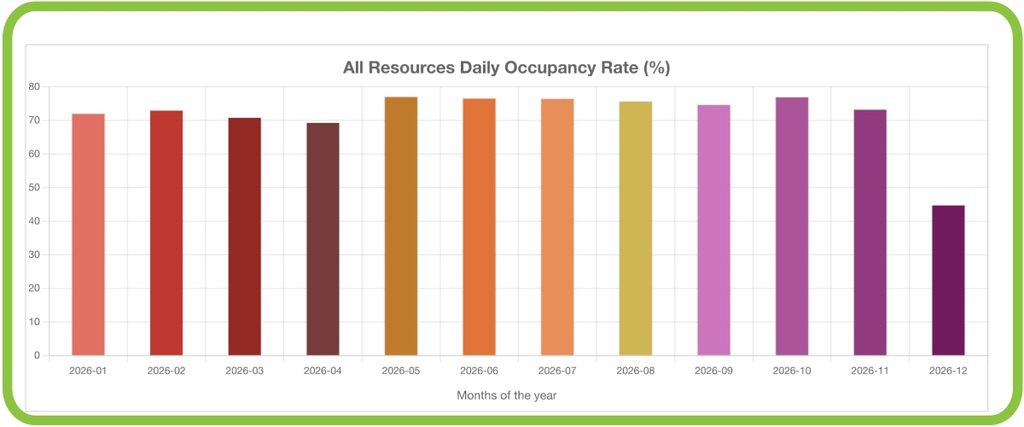
This result means that the rooms were used for 70% of their available capacity. The remaining 30% represents capacity that could potentially be better utilized, depending on the clinic’s needs.
However, a 100% utilization rate is not necessarily desirable. A clinic must maintain sufficient flexibility to accommodate unexpected events, schedule changes, and the needs of its healthcare professionals.
The goal is generally to increase the number of professionals while ensuring that they have access to an office during their preferred periods. Requiring professionals to work part-time, remotely, or during less desirable periods simply to achieve 100% utilization could make recruitment and retention more difficult.
The objective is to strike a balance between efficient space utilization and the flexibility needed to keep the clinic running smoothly.
2. Why Is Space Utilization Rate Important for Your Clinic?
Measuring space utilization helps you better understand your clinic’s actual capacity and identify opportunities for optimization.
Reduce Unused Periods
Rooms that remain unoccupied on certain days or during specific periods may represent an opportunity to improve scheduling. By identifying these periods, you can determine whether other professionals could work during those times or whether availability could be redistributed.
Optimize Real Estate Investments
Adding offices or leasing additional space involves significant costs. Before making such a decision, it is important to understand how effectively your existing rooms are being used.
Data analysis may reveal that certain periods still offer sufficient capacity to accommodate additional activities.
Simplify Scheduling
Managing the availability of multiple professionals quickly becomes complex when each person has their own constraints and preferences.
Greater visibility into room utilization makes scheduling easier and helps coordinate work schedules with available spaces.
Improve Decision-Making
Decisions based on concrete data are generally easier to justify than those based solely on impressions.
By monitoring utilization rates over time, managers can compare results from month to month, identify trends, and measure the impact of changes to work organization.
3. How Can You Identify Your Busiest Days and Periods?
Knowing your clinic’s overall utilization rate is a good starting point. However, this average does not necessarily reveal variations between weekdays or different times of the day.
For example, a clinic might have a weekly utilization rate of 70%, while occupancy reaches 100% on Tuesday and Wednesday mornings but is much lower on Fridays.
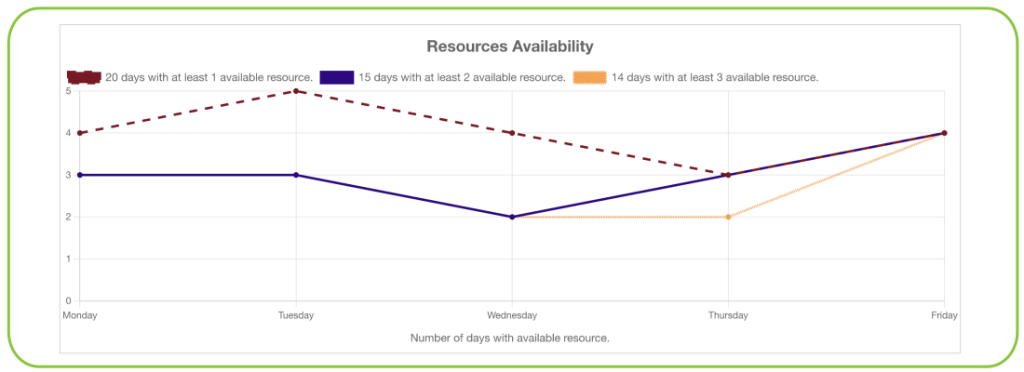
Without a detailed analysis, these differences may go unnoticed.
It is therefore important to examine room utilization across several dimensions:
- By day of the week: Determine which days are busiest and which have more availability.
- By time of day: Identify peak hours and periods when certain rooms remain unused. Many FMGs, for example, may have sufficient office availability in the evenings and on weekends.
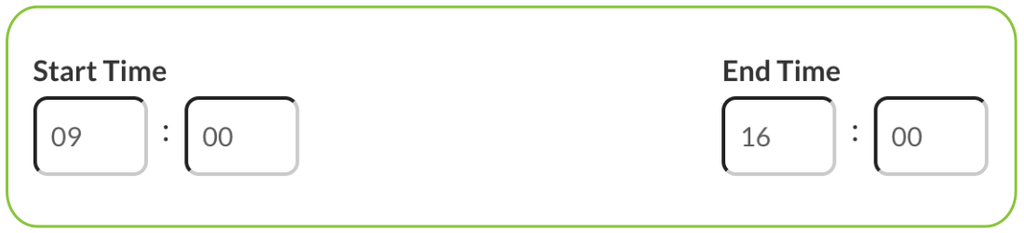
- By room: Identify the most heavily used offices and those whose utilization could be improved.
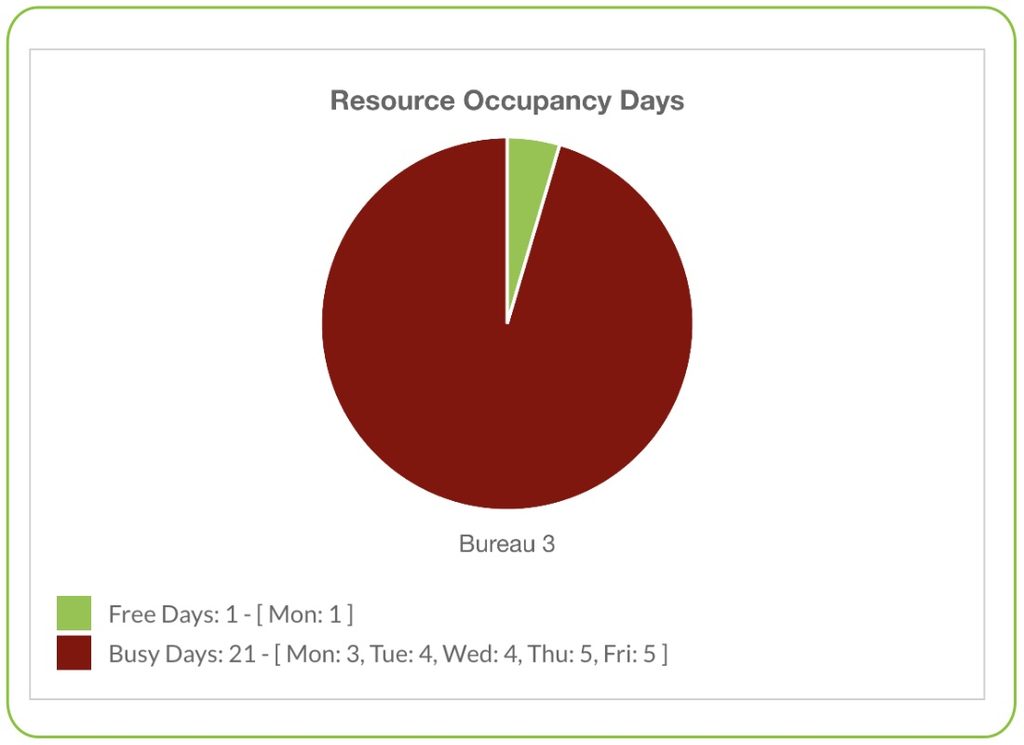
- By office category: Consider the equipment requirements of physicians, physiotherapists, and other professionals, since not every room has the same equipment.
- By type of professional: Determine, for example, whether Office No. 2 is used more frequently by nurses or physicians.
- Over time: Compare months and quarters to identify recurring trends.
This information helps you better understand your clinic’s needs and gradually adjust your scheduling practices.
4. How Can You Improve Your Clinic’s Space Utilization Rate?
Once underutilized periods have been identified, several actions can be considered.
Centralize Availability Information
Bringing together information about professionals’ availability and unavailability makes scheduling easier and reduces the back-and-forth required to determine which resources are available.
For example, you could use a team calendar such as Teamup Calendar to centralize this information.
Schedule Professionals According to Available Space
Better coordination between professionals’ schedules and room availability helps minimize periods when spaces remain unused.
For example, could you ask the nutritionist to take Monday or Wednesday off instead of Friday?
Analyze Trends Regularly
Periodic monitoring helps determine whether changes are producing the expected results and identify new opportunities for improvement.
Automate Repetitive Tasks
When scheduling relies on Excel spreadsheets, bulletin boards, or numerous email exchanges, managers can spend considerable time coordinating availability.
Specialized software can simplify this work and provide greater visibility into the overall situation.
These measures contribute to more structured room management and make it easier for the clinic to adapt as its needs evolve.
5. How Team2Book Helps You Optimize Space Utilization
Team2Book is an availability, room, and scheduling management software designed to simplify coordination among professionals in clinics and multidisciplinary teams.
The platform centralizes professionals’ availability, manages rooms, and automates room assignments based on the clinic’s needs and established rules.
Team2Book offers more than 15 real-time statistics to help managers better understand how their organization operates and identify opportunities for improvement.
With these statistics, you can:
- Identify the busiest periods and days of the week.
- Detect activity variations and periods that require particular attention.
- Better understand how available resources are being used.
- Track various management indicators to support decision-making.
- Gain greater visibility into scheduling and room assignments.
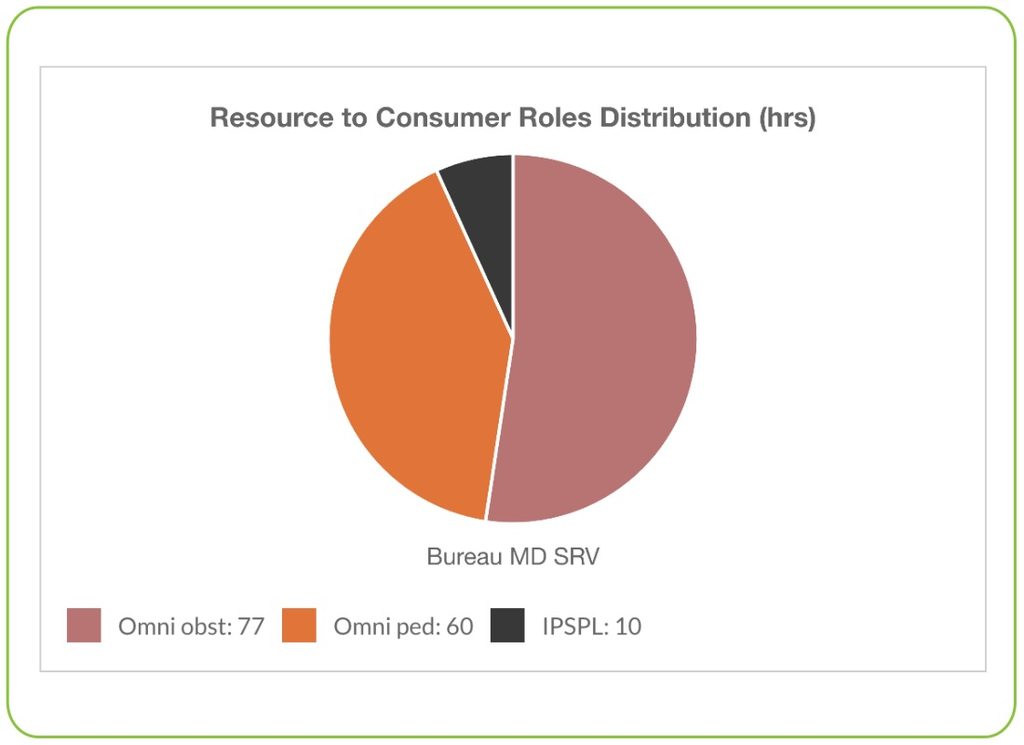
These insights make it possible to move from a management approach based primarily on experience and day-to-day observations to a more structured, data-driven approach.
Rather than performing multiple manual checks, managers have access to up-to-date, real-time information to plan activities more effectively and evaluate opportunities for optimization.
Conclusion: Turn Your Statistics into Opportunities for Improvement
Space utilization rate is a valuable indicator for any clinic looking to improve its operations, make better use of its facilities, and plan for growth.
By measuring this indicator and analyzing variations by day, time, and room, you can identify opportunities for improvement that might otherwise go unnoticed.
But making good decisions requires having the right information at the right time.
With its availability and room management features, along with more than 15 real-time statistics, Team2Book helps you better understand how your resources are being used and optimize your clinic’s operations.
Want to make better use of your clinic’s space?
Discover how Team2Book can simplify availability management, improve coordination among your professionals, and help you make informed decisions.